Pets
In February, Gov. Spencer Cox declared 2024 a “No-Kill Shelter Year” to spread awareness about shelter practices and push Utah to become the first no-kill state in the West. The biggest roadblock to achieving that goal is the high kill rates among feral cat populations in two Utah County shelters. These can be attributed to policies that lag behind the rest of the nation and one shelter verbally speaking out against nationally accepted no-kill practices that most shelters in Utah have adopted.
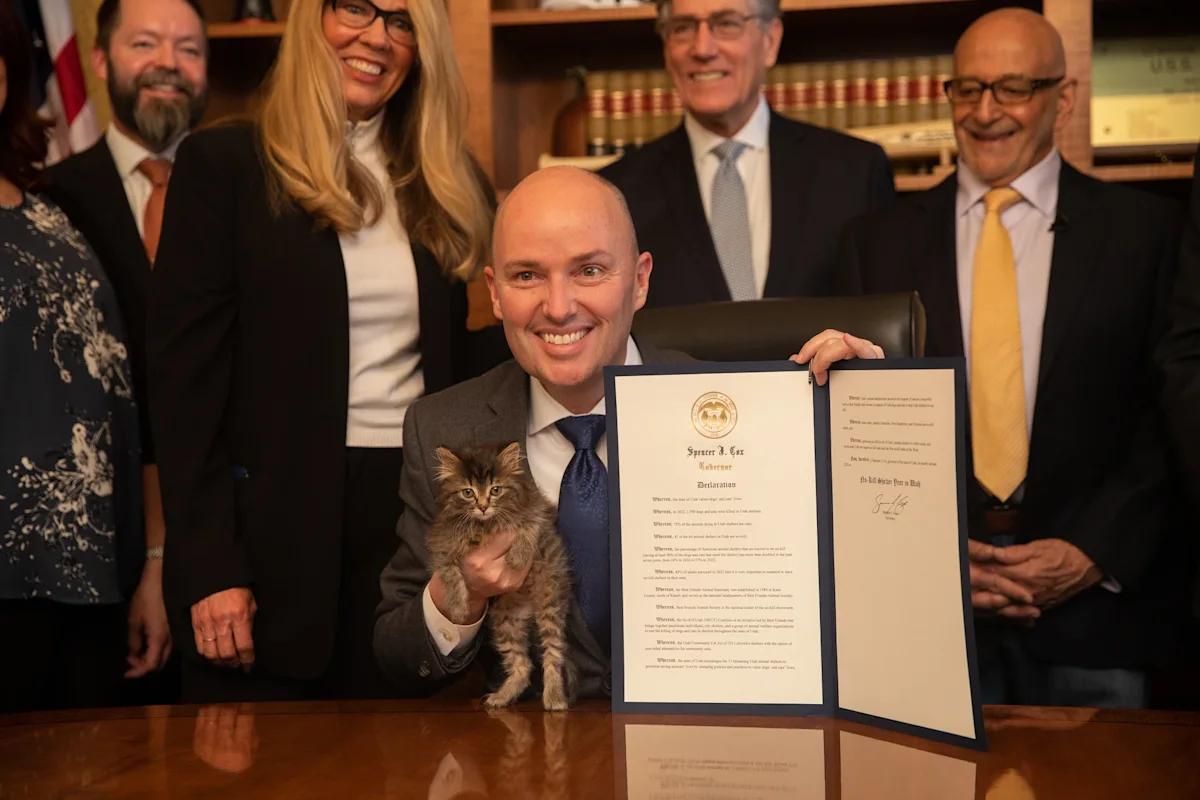
Photo courtesy of Best Friends Animal Society
Utahns continue to show their ability to lend a helping paw. Adoption rates remain high throughout the state, and pets are being bought at higher rates. Unfortunately, the latter can lead to more pets being turned into local shelters and unnecessarily euthanized.
Shelters know that around 10% of animals taken in have debilitating conditions or behaviors that affect quality of life. Thus, to be qualified as no-kill facilities, shelters are asked to save 90% of the animals that enter them.
And we’re doggone close. Of the 59 shelters in Utah, 45 have no-kill status; Utah’s current save rate is 87.6%. But the challenges that remain emphasize a need for public participation.
In some aspects, the two shelters in Utah County have achieved a no-kill goal; the save rate for dogs there is 90%. But at North Utah Valley Animal Shelter, for instance, only 50% of cats leave the shelter alive according to Best Friends Data, which was acquired via the government records access and management act (GRAMA).
Adoption is one way to avoid euthanasia. But when it comes to stray cats, it’s been shown nationwide that the most effective method to avoid euthanasia is for shelters to enact trap-neuter-vaccinate-return programs.
Most shelters in the state have adopted these best practices and accepted private support from Best Friends Animal Society to follow through. These programs safely trap, neuter/spay, vaccinate, then return feral cats to where they were originally found. It’s also less expensive, eliminates nuisance behaviors and prevents the spread of disease.
Not all shelters have jumped on board with these policies, and it’s particularly apparent at NUVAS in Lindon and South Utah Valley Animal Shelter in Spanish Fork. Nearly two-thirds of all the animals being killed in Utah happen at these two shelters in Utah County, specifically among the community cat population.
Best Friends says it has made multiple attempts to partner with NUVAS and provide free resources, but director Tug Gettling hasn’t accepted any of the offers. In the past, he has spoken against the practices and called them ineffective.
However, the National Animal Control Association, Best Friends Animal Society, American Society for the Prevention of Cruelty to Animals and International City Managers Association have all endorsed TNVR as the most effective and humane solution for stray cats.
In a recent administrative board meeting on June 27, 2024, Gettling again rejected financial help from Best Friends Animal Society. Lack of transparency also seems to be a factor when it comes to policy change. For example, NUVAS does not freely share their meeting minutes or records for impounded animals like most shelters do. This makes it hard for the public to stay informed on matters at the shelter. However, these meetings are public, and all who attend are encouraged to show their support for no-kill policies.
Chief Mission Officer Holly Sizemore from Best Friends Animal Society noted, “Utah County has simply refused to adopt contemporary no-kill practices that would get them to no-kill status. And it’s a failure of the shelter leadership, the service district boards, and the elected officials who oversee those boards.”
Last year’s save rate for Utah’s shelters outside of Utah County was 90.3%, leaving Utah County to have the only shelters in the state with save rates below 90%. NUVAS’ save rates also decreased from 2022 to 2023, reiterating that TNVR could be a more effective method to deal with community cats.
“All other larger counties in Utah have supported or run their own TNVR programs including Davis, Salt Lake and Weber Counties, and they’re all no-kill. The shelters in Utah County have continually refused to adopt TNVR programs claiming they are ineffective. However, their data continually shows that their current practices are not effective; they are killing half of the cats that enter their facility which shows that change is not only needed at this point but is absolutely necessary,” Sizemore said.
There are several ways to help make life-saving changes in Utah. But for the issue at hand in Utah County, one of the best things you can do is directly communicate your desires for no-kill practices to be implemented within your city and county shelters.
Locals are encouraged to advocate for the adoption of TNVR policies at both Utah County shelters.
The next board meeting is at 10 a.m. on Aug. 29, 2024 at the Pleasant Grove Police Department.
Additionally, fill out this form asking your county and city leaders to stop impounding and killing healthy cats.
More than 80% of Americans believe having a no-kill shelter is important to their community. In Utah, the percentages are similar. In a recently conducted survey in Utah County, “Of the voters polled, an astounding 72% indicated they either Somewhat (30%) or Strongly (42%) Support implementing a Trap-Neuter-Vaccinate-Return program in their community”; 76% of those polled believe local governments should accept free help to offer such life saving practices.
It was also found that “The appeal of TNVR grew significantly when the life-saving value proposition was shared, indicating further evidence that the public places much significance on the lives of stray or homeless pets.” Utahns love to lend a helping paw.
Roughly 7 million people in America acquire pets each year. If only 6% of those 7 million people chose to adopt, that would end shelter killing in the country. In 2023, 2,079 cats and dogs were killed in Utah. If around 2,000 Utahns adopted instead of buying from a breeder or pet store, we’d be considered a no-kill state. Compare that with our Idaho neighbors, who only have to save a little under 400 animals to achieve the same goal.
Looks like we’ve got some friendly competition to see who can become the first Western state to reach a no-kill status. Take a look at adoptable pets on KSL Classifieds to get a head start.
Public adoption events are a great way to find that four-legged friend you’ve been missing. Attend an event like Best Friends Strut Your Mutt that KSL Classifieds has sponsored or visit a local shelter to find a pet to adopt.
You can also volunteer at a Best Friends location to help find homes for pets.
Browse KSL Classifieds Pets — we pull information from Petfinder to find adoptable pets from reputable shelters. Visit Best Friends Animal Society’s website to find more ways to help. And join us on our mission to become a no-kill nation by 2025.